The perpetual struggle for a just society
For my 85th birthday, April 3, Susana arranged for us a trip that she knew was tremendously important to me, for reasons both professional and personal: our visit to Hamburg and then to Kiel in northeast Germany, from March 31 to our return to Spain on April 9.
A birthday is always an opportunity, or even a requirement, to rethink one’s life so far and decide upon the next stage. And at 85, I think that I have finally collected the necessary experience and skills to tackle my next big literary challenge, a novel that will follow the themes of my earlier novel Rabble!, about how Parisian workers and their allies overthrew the exploitative and misery-perpetuating regime in what was then — spring of 1871 —Europe’s most powerful metropolis, the political and financial capital of one of the world’s most extensive empires. To replace it, they created and defended with their blood the radically democratic and egalitarian social system they called the Commune.
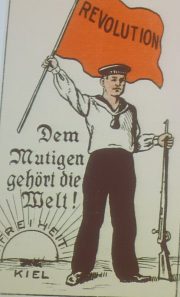
The Paris Commune was finally, after about two months, crushed and tens of thousands of its defenders slain by the overwhelming artillery and infantry force of the French reactionary government, supported by and subservient to the Prussian army that had just defeated it. But this revolutionary spirit can never be totally and permanently extinguished. And one of the places where it broke out again most powerfully was in Germany, from its initial explosion in the Baltic seaport of Kiel in November 1918, in a sailors’ mutiny that sparked the German revolution of 1918-1919 and fostered the creation of the Weimar Republic, the most progressive and egalitarian government at that time anywhere in Europe.
And this is where my new novel begins, as part of my continuing exploration to understand and explain not only how and why we humans struggle to create a truly humane, solidary and socially equal society, but also the tremendous obstacles from outside and also the conflicts within those movements that all too often doom such efforts.
In the first week of November 1918, as Germany was fast approaching total defeat in its long war against surrounding countries and now even the armed forces of the United States, the German imperial admiralty emitted a secret order to commanding officers in Wilhelmshaven and Kiel, the two main naval ports, to prepare the High Seas Fleet to send out its enormous battleships — many of which had crews of a thousand men and enormous cannons and powerful emgines — for a last, glorious battle against the British Royal Navy. But the empire’s sailors got wind of this order, and revolted, taking over the whole city of Kiel and sparking other revolts — of sailors, soldiers and organized workers, men and women — which spread across Germany. This new novel begins with a young sailor and his girlfriend, a shipyard worker, who become parts of that uprising and whose subsequent life and struggles are shaped by that experience.
This is a complex period that I have long wanted to understand, to explain both the rise of Nazism and the rapid growth and power of world communism that opposed it, and of course World War II, the civil war in Spain, and the sequels of these conflicts have shaped the world we live in now. And I feel that I am now, finally, ready to take on this task, having written my previous novels on other great social conflicts — especially the most recent one, on the Paris Commune, and other articles on struggles in Poland, Latin America and the Balkans.
And I am very grateful to a number of people who have encouraged me and offrered me resources to carry out this task. Among them are faculty at Leeds University in England, especially Ingrid Sharp and Corinne Painter, who have recommended bibliographic sources and even sent me very relevant articles, especially focused on women’s participation in revolutionary movements in Germany at the end of the first world war; Keith Bird, a scholar who, among other things, has collected and shared with me an extensive bibliography of the German Imperial Navy of 1871 to 1918; and Klaus and Renate Kuhl, in Kiel, who have gathered and published invaluable historical records, including interviews from the 1980s of some surviving witness of the uprising in Kiel in November 1918 and have even produced a documentary film on the Matrosenaufstand. Klaus met with me in Kiel, and generously gave me a copy of a book on one of the key figures in that revolt, and has offered to be available for consultation as I continue my research.
In the great city of Hamburg , Germany’s second largest (after Berlin), I got to see the port from which my great grandfather, Adam Fuchs, a poor lad of 16, set out for America in 1867. And also to visit the enormous Maritime Museum, to learn some more about the ships and lives and routines of the sailors who will be key in my novel. And, as a special treat, we got tickets to a marvelous concert in what is considered Europe’s most advanced concert hall, the Elbphilharmonie.
But more important for my present project, our trip to Kiel, a port on a protected inlet known as the Kieler Förde (fjord) that connects it to the Baltic Sea. There we were able to visit the most important sites of that sailors’ uprising of November 1918. Other highlights included, besides meeting Klaus Kuhl, who has contributed so much to our understanding of that episode, a visit to the Kiel Schifffahrts Museum, where I could see posters, sailors’ tools and photographs from those tremendously exciting first weeks of revolutionary fervor in 1918, and also acquired a marvelous little book — given out for free, in versions in English and German— that details very clearly the events leading up to and during that revolt. And we also took a boat from Kiel on the Förde to Laboe, on the edge of the Baltic Sea, to see what that trajectory would have been were the great battleships to have been sent out toward Denmark, Norway, Poland or Russia, or to sail around the tip of the Jutland peninsula, past Norway and Denmark and into the North Atlantic to engage the British fleet.